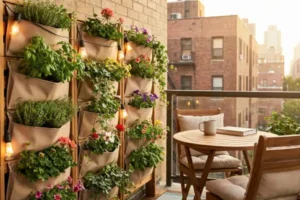
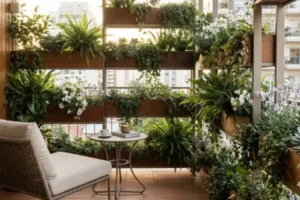
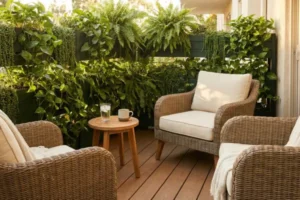
Lighting ideas to highlight your vertical garden are one of the best things you can do for your gourmet balcony. When the sun goes down, the right lighting does not just fill the dark — it turns your plant wall into the most beautiful thing on the entire balcony. If you have ever felt like something was missing out there at night, this is probably it.
A gourmet balcony is already a place worth taking care of. It is where good meals happen, where friends gather, and where you finally get to breathe after a long day. A vertical garden adds life and texture to all of that. But when the lights go out, even the most stunning plant wall disappears — and that is a shame.
In this article you will find practical and genuinely beautiful ways to light your vertical garden after dark. Whether you have a compact modular vertical garden for gourmet balconies or a larger setup covering an entire wall, there is something here that will work for your space and your budget.
Why Lighting Makes Such a Difference for a Vertical Garden at Night
Most people spend a good amount of time choosing the right plants for their vertical garden. They think carefully about which herbs, ferns, or flowering plants will thrive in their climate and light conditions. But then the lighting gets treated as an afterthought, something to be figured out later. The result is a garden that looks stunning during the day and virtually invisible at night.
Here is the thing — a vertical garden has a unique structure that responds to light in fascinating ways. The layered arrangement of plants, the varying leaf textures, the shadows and depth created by a well-placed modular vertical garden for gourmet balconies — all of it comes alive when you shine the right kind of light on it. A single well-aimed spotlight can turn a flat green wall into something that looks like a piece of living art.
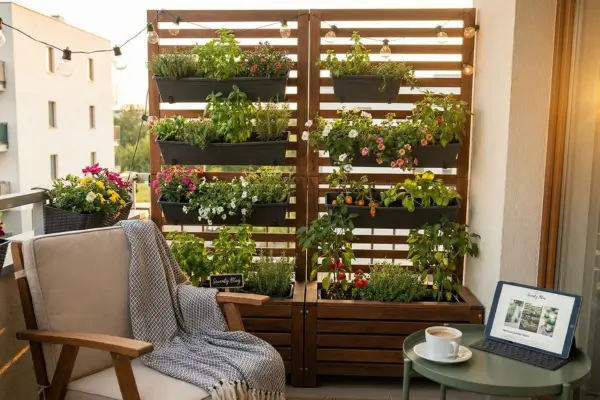
Think about restaurants and hotels you have visited that had outdoor garden walls lit up at night. That warm, inviting glow did not happen by accident. It was the result of deliberate choices about fixture placement, light temperature, and intensity. The good news is that you can achieve the same effect at home, and it does not require a professional designer or a massive budget.
Understanding Light Temperature and Why It Matters for Plants
Before you buy a single bulb or fixture, it helps to understand one basic concept: color temperature. Measured in Kelvins, color temperature tells you whether a light source produces a warm, yellowish glow or a cool, bluish-white light. For a vertical garden, this matters both visually and practically.
Warm white light, typically in the range of 2700K to 3000K, tends to bring out the richness of green foliage. It gives leaves a lush, almost golden quality that reads as cozy and inviting. This is usually the best choice for a gourmet balcony where the goal is atmosphere as much as visibility.
Cool white light, around 4000K to 5000K, is crisper and more clinical — it works better in modern, minimalist spaces or when you want to highlight specific architectural details.
There is also the question of whether your lights will double as grow lights. Most decorative outdoor fixtures are not designed to support plant photosynthesis, and that is fine for plants that get adequate daylight.
But if your balcony is in a shaded area or you are growing herbs that need a little extra help, you might want to consider full-spectrum LED panels that serve a dual purpose, keeping your plants healthy while also creating a beautiful visual display at night.
The Best Types of Lighting Fixtures for a Vertical Garden
Choosing the right fixture is where the fun really begins. Most well-designed balcony gardens combine two or three different types to create that layered, dimensional look that makes people stop and stare.
String Lights: Simple, Warm, and Always Charming
String lights are probably the most accessible option, and there is a reason they show up on every balcony inspiration board on the internet. They are affordable, easy to install, and they cast a warm, diffused glow that flatters just about any type of plant. Woven through a modular vertical garden for gourmet balconies, they add a festive, almost magical quality to the space.
The key with string lights is not to let them do all the work on their own. They are best used as a layering element rather than the primary light source. Pair them with a more focused fixture to get depth and dimension. Also, look for weatherproof, outdoor-rated string lights with warm white LED bulbs — they last longer, use less energy, and hold up well against rain and humidity.
Spotlights and Uplighting: Drama and Definition
If you want your vertical garden to look like it belongs in a five-star rooftop restaurant, spotlights are your best friend. Placed at the base of the garden and angled upward, they create dramatic uplighting that makes the entire plant wall pop against the night sky.
This technique emphasizes height and draws the eye upward, which is particularly effective when your garden spans a full wall from floor to ceiling.
You can also use small spotlights mounted above the garden, aimed downward at a slight angle. This downlighting approach is softer and more natural-looking, similar to how sunlight would fall. Many homeowners use a combination of both — uplighting for drama, downlighting for fill — to get a balanced and polished result.
Recessed and Built-In LED Strips: Clean and Modern
For a sleek, contemporary look, LED strip lights installed directly into the structure of your vertical garden panels are a fantastic option. Many modular vertical garden systems are designed with channels or grooves that accommodate LED strips, allowing you to integrate the lighting seamlessly into the garden itself. The result is a soft, even glow that comes from within the garden rather than from an external source.
This approach works especially well in modern apartments and urban balconies where clean lines and minimalism are part of the overall design language. The lights become part of the structure, and when turned on at night, the garden appears to be glowing from the inside. It is a subtle effect, but an incredibly powerful one.
How to Layer Your Lighting for the Best Visual Effect
Good lighting is rarely about a single fixture doing all the work. The real magic happens when different light sources work together, each playing a specific role in the overall composition.
Start With a Base Layer of Ambient Light
Layering is the secret that professional lighting designers use in every project, and it works just as well on a home balcony. The idea is to build your lighting from the ground up, starting with ambient light that illuminates the entire space broadly.
This could be overhead string lights, a ceiling-mounted fixture, or even a nearby lantern. The ambient layer sets the mood and ensures that no part of the balcony is left in total darkness.
Once your base layer is in place, you can start adding accent lights that draw attention to specific parts of the vertical garden. Maybe there is a cluster of bromeliads in the upper-left corner that you want to highlight, or a row of trailing ivy that looks stunning when backlit. Accent lights let you be intentional and artistic about what the eye sees first when someone steps onto the balcony.
Add Task Lighting Where You Actually Need It
A gourmet balcony is not just a place to look at — it is a place to cook, eat, and spend time in. That means you also need functional task lighting for the areas where you are preparing food, setting the table, or pouring drinks. Undercabinet lights, pendant fixtures over a bar or counter, and adjustable wall sconces all work well for this purpose.
The trick is to make sure your task lighting complements rather than competes with your garden lighting. If your task lights are very bright and harsh, they will wash out the softer, more atmospheric glow of your vertical garden at night.
Dimmer switches are a simple and affordable solution — they let you adjust the intensity of different lighting zones throughout the evening depending on what you need.
Use Shadows as a Design Element
Here is something that most people do not think about until they see it done well: shadows are part of the design. When light hits a dense plant wall at an angle, it throws complex, organic shadow patterns onto the surrounding surfaces. A fern in front of a spotlight will cast a beautiful, lacy shadow on the wall behind it. A cluster of succulents lit from below will create bold, sculptural shadows that add depth and drama.
The next time you are experimenting with fixture placement, do not just look at the plants — look at what the light is doing to the walls, ceiling, and floor around them. Sometimes the most beautiful part of the composition is not the garden itself but the shadow it casts.
Solar vs. Electric Lighting: Which One Is Right for Your Balcony?
This is one of the most common questions people have when planning outdoor garden lighting, and the honest answer is that it depends on your specific situation. Solar-powered fixtures have come a long way in the past several years, and many of them now produce enough light to be genuinely useful rather than just decorative. They are easy to install since there are no wires to run, and they cost nothing to operate once you have them in place.
That said, solar lighting has real limitations on balconies. If your gourmet balcony does not receive several hours of direct sunlight each day, the panels will not charge adequately and the lights will be dim or unreliable. Balconies that face north or are shaded by a building or awning are particularly problematic for solar fixtures. In those cases, wired electric lighting is the more dependable choice.
For most people, a hybrid approach makes the most sense. Use solar-powered string lights or lanterns for decorative accent lighting where reliability is less critical, and rely on wired fixtures for the primary lighting that you genuinely need to function and entertain. This gives you the flexibility of solar where it works and the dependability of electric where it matters most.
Smart Lighting Controls for Outdoor Vertical Gardens
Technology has made it easier than ever to manage your outdoor lighting without thinking twice about it. A few simple controls can completely change how you interact with your balcony after dark.
Timers and Schedules
One of the simplest upgrades you can make to any outdoor lighting setup is a timer. Set your vertical garden lights to come on automatically at sunset and turn off at a reasonable hour, and you never have to think about it again. Timers are inexpensive, easy to install, and they prevent the all-too-common scenario of forgetting to turn the lights on and missing a beautiful evening outside.
Smart plug-in timers that work with your home Wi-Fi are especially handy. You can control them from your phone, adjust the schedule seasonally as sunset times change, and even set them to respond to sunrise and sunset automatically rather than a fixed clock time.
Dimmers and Scene Controllers
If you want a more polished, flexible experience, dimmers and smart scene controllers let you program different lighting moods for different occasions. You might have a bright, energetic setting for when you are hosting a dinner party, a softer and more romantic setting for a quiet evening with your partner, and a very dim, minimal setting for late-night winding down.
Smart systems from brands like Philips Hue, Lutron, and LIFX make this kind of multi-scene control accessible even for people without any technical background.
Voice Control and Home Automation
For the tech-savvy balcony owner, integrating your outdoor garden lighting into a broader home automation system is a genuinely enjoyable upgrade. Telling your smart speaker to turn on the garden lights, dim them to fifty percent, or shift to a warmer color temperature is both convenient and a little bit fun. If you are already using a platform like Amazon Alexa, Google Home, or Apple HomeKit indoors, extending it to your balcony is usually straightforward.
Practical Tips for Installing Outdoor Lighting Safely
A beautiful lighting setup is only as good as the installation behind it. Taking a few extra steps during the process saves you from headaches down the road and keeps everything looking great for years to come.
Always Choose Outdoor-Rated Fixtures
This seems obvious, but it is worth saying clearly: never use indoor lighting fixtures outside. Outdoor-rated fixtures are built to handle moisture, temperature swings, and UV exposure. Look for an IP rating on the product — IP44 or higher is suitable for most balcony environments, while IP65 or higher is better for areas directly exposed to rain.
Plan Your Wiring Before You Install Anything
Nothing is more frustrating than finishing a beautiful lighting installation and then realizing the cables are visible and messy. Before you start mounting fixtures, plan the route your wiring will take. Use cable channels or conduit to keep everything tidy, and make sure all connections are properly weatherproofed. If you are not comfortable working with electrical connections, hire a licensed electrician — the cost is modest and the peace of mind is worth it.
Here are a few things to keep in mind when planning your installation:
- Check that your balcony has enough outdoor electrical outlets for the number of fixtures you want to use.
- Make sure extension cords are rated for outdoor use if you need them.
- Keep fixtures away from areas where water pools or collects.
- Test your lighting setup before finalizing any permanent mounting decisions.
Plant-Specific Lighting Ideas That Actually Work
Different plants respond to light in different ways, and understanding this can help you make smarter decisions about fixture placement when applying lighting ideas to highlight your vertical garden.
Ferns, for example, have delicate, feathery fronds that look absolutely stunning when backlit. Placing a small spotlight behind a fern section of your vertical garden creates a translucent, glowing effect that is hard to achieve with any other plant. Succulents, on the other hand, have bold geometric forms that look best under direct, angled light that emphasizes their three-dimensional structure.
Herb gardens are a popular feature of modular vertical garden for gourmet balconies, and they respond beautifully to warm, close-range lighting. Basil, rosemary, and thyme all have interesting leaf textures that catch light in different ways.
A simple adjustable spotlight aimed at your herb section not only looks great but also makes it easier to identify and harvest your herbs at night, which is genuinely useful during evening cooking sessions.
Flowering plants deserve special attention. If you have jasmine, bougainvillea, or any other flowering species in your vertical garden, directing a soft, warm spotlight at the blooms will make them glow with color. This works particularly well for white or pale-colored flowers, which seem almost luminous under warm LED light.
Budget-Friendly Lighting Ideas That Still Look Expensive
You do not need to spend a fortune to achieve a beautiful lit vertical garden. Some of the most visually striking results come from simple, affordable choices made thoughtfully.
A string of warm white solar fairy lights woven through your plant panels costs very little and creates instant atmosphere. A pair of small solar spotlights placed at the base of the garden, angled upward, adds drama without any wiring. Battery-operated LED puck lights, attached discreetly to the frame of your modular panels, can provide surprisingly effective accent lighting in areas where running wires would be difficult.
The key principle is to focus on placement over price. A twenty-dollar spotlight in exactly the right position will always outperform a hundred-dollar fixture placed carelessly. Take the time to experiment with positioning before you commit to permanent installation, and you will almost always end up with a better result.
Frequently Asked Questions About Lighting a Vertical Garden at Night
Many people have similar questions when they start thinking about outdoor garden lighting, so here is a roundup of the ones that come up most often. Whether you are just getting started or refining an existing setup, these answers should help point you in the right direction.
What kind of lights are best for a vertical garden at night?
Warm white LED lights in the 2700K to 3000K range are generally the best choice for a vertical garden. They enhance the natural green of foliage, create a welcoming atmosphere, and are energy-efficient enough to run for extended periods without significant electricity costs. Spotlights, strip lights, and string lights are all popular formats depending on the look you are going for.
Can I use solar lights for my balcony vertical garden?
Yes, but with some caveats. Solar lights work well on balconies that receive several hours of direct sunlight each day. If your balcony is shaded or faces north, solar panels will not charge adequately and the lights may be dim or inconsistent. In those cases, wired or battery-powered options are more reliable.
How do I waterproof my balcony lighting?
Choose fixtures with an IP44 rating or higher for standard balcony use. Make sure all wire connections are sealed with weatherproof wire nuts or covered junction boxes. If your balcony is directly exposed to rain, opt for IP65-rated fixtures and run wiring through conduit or cable channels to protect it from moisture.
How many lights do I need for a vertical garden wall?
This depends on the size of your garden and the effect you want to achieve. As a general guideline, plan for one spotlight or accent light for every four to six square feet of garden area. Start with fewer fixtures and add more as needed — it is easier to add light than to deal with a space that feels over-lit and harsh.
Will lights hurt my vertical garden plants at night?
Standard decorative LED lights do not produce enough heat or UV output to harm most plants. In fact, some plants benefit from supplemental light if they are not getting enough natural daylight. The main thing to avoid is placing high-intensity fixtures in very close contact with foliage, as this can cause heat stress in sensitive plants.
What is the best way to highlight a modular vertical garden for gourmet balconies?
A layered approach works best — combine ambient string lights with focused spotlights and built-in LED strip lights for depth and dimension. Pay attention to the types of plants in your panels and aim lights in ways that emphasize their specific textures and forms. Using a dimmer or smart controller gives you the flexibility to adjust the mood depending on the occasion.
Can I integrate my balcony garden lights with a smart home system?
Absolutely. Many outdoor-rated smart plugs, smart bulbs, and smart fixtures are now available and compatible with popular platforms like Amazon Alexa, Google Home, and Apple HomeKit. These allow you to control your lighting remotely, set schedules, and program different scenes for different moods or occasions.
Bringing It All Together: Your Lit Vertical Garden as the Heart of the Balcony
A well-lit vertical garden changes the whole feeling of a gourmet balcony at night. What was a beautiful space during the day becomes something truly special after dark — warm, alive, and impossible to ignore.
The lighting ideas to highlight your vertical garden that work best are always the ones that feel like yours. Start simple, experiment a little, and let the space tell you what it needs. There is no single right answer, and that is actually the best part of the process.
Do not rush it. Some of the most stunning balcony gardens out there started with just a few string lights and grew over time into something remarkable. Yours can too.
If this gave you some ideas, check out our other articles on balcony design and vertical gardens on the Seventy Blog. Until next time!